 |
 |
|
|
"The Australian Army's most POWerful Land-Rovers"
The Land-Rover 'Gunbuggy' variant conversions were carried out on some
(existing) Series 2 and (brand new) Series 2A ¼ ton G.S. Land-Rovers
in the 1963-64 for the use in the Anti Tank role. The Army procured
72 of the 106mm RCL guns for use on Land-Rovers and M113 APCs. The Gunbuggy
conversions on SWB Land-Rovers were carried out by RAEME (3 Base Workshops
Broadmeadows Vic) and there some 'in-service' as late as 1996 (!!!!),
seeing activity in Vietnam in their first decade of service. The Gunbuggy was the primary medium-range anti-armour weapon of RAR. How many Gunbuggys were made and 'in-service'? Reference info on the Gunbuggy was as good as non-existant until Mike Cecil, a researcher attached to the Australian War Memorial, published his article detailing the Australian Army's platforms for their M40A1 106mm Recoilless Rifles (Army magazine 8/02):
88" Gunbuggy Conversion details:
Operational Information:
The Australian engineered and built Gunbuggy variant is the longest serving Land-Rover conversion to date. There were withdrawn from service in the middle of the 1990's. Expensive conversions were not replaced as often as G.S. variants of course, but this is also a case of not needing or not having something to supercede the 106mm RCL. It is the "relatively perfect" anti-armour weapon, in that a 106mm slug will penetrate armour; deeply and profoundly. So mechanical components were replaced (such as motor and drivetrain) as the years went by. Another example of long service is the Ambulance conversion (aka blood box) that spent years 'in-service' from 1963 to 1991, also because of the prohibitive replacement costs of the bodywork. The below photos illustrate the layout of a Gunbuggy and
are taken from RAAC Training Vol 3 Pam 2 106mm recoilless rifle M40A1
1963. |
||
 
|
 |

|
|
||
| Land-Rover Series 2 Gunbuggy |
|
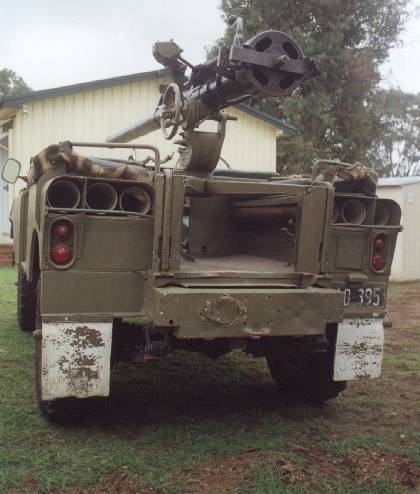
The Series 2 Gunbuggy pictured below was with the 8/9 RAR (Royal Australian Regiment) "Heavy Weapons Platoon" until taken "out of battle order" in 1995/96. This gunbuggy (sometimes called 'sportscar') is the first / earliest issued; Army Registration Number, 110-395. ref Gunbuggy ARN's It is only part of the fascinating and extensive
Infantry Corps weaponry, uniforms, maps, diaries, battlefield souveniers
and memorabilia collection at The Royal Australian
Infantry Corps Museum (website)
Address: |
| Make | Land-Rover (Rover Australia P/L) | Model | SWB 88" Series 2 |
| Manuf. date | 16/12/58 | Production | CKD RHD export |
| Army Census | 6005 | Engine | Petrol 2286cc |
| Nomenclature | TRUCK. COMMAND RECONNAISSANCE. ¼ TON. LAND ROVER SERIES 2 |
Contract | number C104337 |
| Chassis | 143901279B | ARN | 110-395 |
Rifle dated 16/08/61 serial 13564 weight 465 lbs
|
|
|
 Click here for big pic
|  Click here for big pic
| 
|
|
|
|
 |  |  |
| Land-Rover Series 2A Gunbuggy |
Bandiana Series 2A exhibit |
John's Series 2A Gunbuggy pics |
| Series 2A on exercise  medium size big size | Dennis' Series 2A Gunbuggy pics  big size |
| Land-Rover Gunbuggy "In Service" |
The below photographs came from John Schroeder and this is what he had to say about the photos and the vehicles as he recalls them.
|
|
 Copyright John Schroeder |
|
A list of
known Gunbuggy ARN's
More details on Australian Military
Land-Rovers fleet numbers and paint schemes.
 |
 |


